Facial recognition check-in is no longer experimental. It has already been used at events for years, and face-enabled event check-in value becomes obvious the moment large volumes of people begin to arrive. At Innovation Week 2025 in Prague, we had the opportunity to put our approach into a clear, measurable comparison.
We operated a face-enabled fast track lane alongside the standard QR entry and monitored how both performed under real conditions. The results showed that facial recognition delivers a faster flow of attendees, a smoother first interaction, and a fully secure check-in process for events at scale.
This is the story of how it worked, what the numbers say, and why it’s a milestone for events that need to get thousands of people in within 30–40 minutes without turning entrance into an airport at Christmas situation.
The starting problem: innovation on stage, queues at the door
Innovation week is the kind of event where AI, automation, and computer vision are on stage all day. That creates a very specific kind of pressure: you can’t have a keynote on the future of frictionless experiences… preceded by 3000 people digging for a QR in their Gmail.
The organizers knew it. They were expecting 3500 registered visitors and most of them arriving in a tight window. That’s the danger zone for event ops: even a small slowdown at the doors suddenly translates into long lines, frustrated partners, and staff improvising. What they wanted instead was:
- to speed up the actual act of letting someone in
- to offer a better experience to visitors who like to try new things
- to keep QR for coverage and safety
- and to get real-world data on whether facial recognition is actually worth it for 2026 and beyond.
This is where we enter with Trucrowd Skip the Line track.
A two-track entry system (with real-world guardrails)
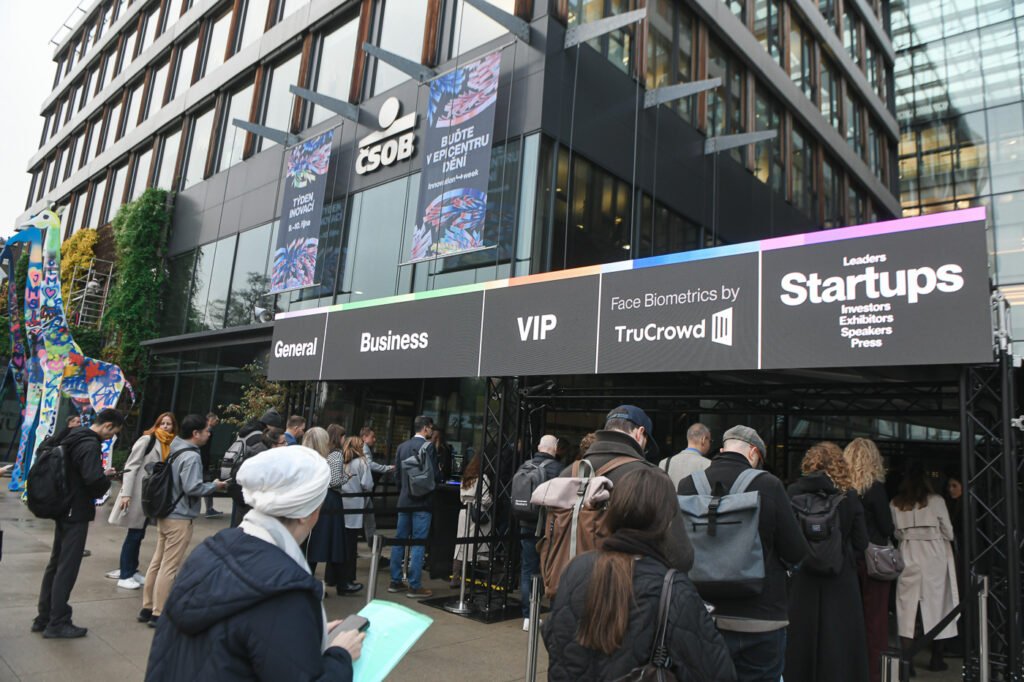
We didn’t show up with a “replace everything with AI” pitch. We brought something more realistic: a dual-rail check-in setup.
- The standard track with QR code scanning and automatic badge printing. This was deployed on 7 of the 10 entry gates. It’s the workhorse flow: anyone with a ticket can get in, staff knows it, attendees know it.
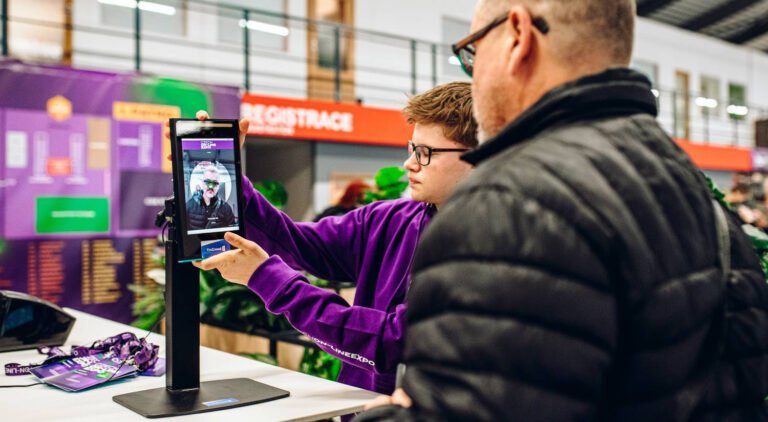
- The fast track using facial recognition + automatic badge printing. This was a dedicated lane for people who opted in. No QR, no phone, no searching. You walk up, the camera recognizes you, badge prints, you’re done.
The facial lane was running side by side with the QR lines. That made the comparison fair.
How we got people to use it
Facial recognition is opt-in tech. If you spring it on people at the door, you get friction, questions, and probably a few “no thanks.” Trucrowd avoided that by using the simplest growth channel in B2B events: email.
Before the event, registered visitors received a message along the lines of:
“Do you want to get in faster? You can register your face for free and use the fast lane.”
That tiny piece of UX did three things at once:
- it announced innovation – people knew the event was trying something new
- it made the choice explicit – no one was forced into face check-in
- it set expectations – if you want the fastest entry, you have to do one minute of prep
The response? Out of 3,382 registered visitors, 316 people opted in for facial recognition. That’s roughly 10% of attendees choosing the new way voluntarily, without incentives, just because the value prop (“you get in faster”) was clear. If the offer is simple and the benefit is obvious, plenty will try it.
So… was it actually faster?
We measured the fast-lane performance during the event. The face-based entry lane achieved 16 successful recognitions and badge prints per minute. That’s not “up to 16,” that’s 16 people per minute actually going through.
Even with 7 gates doing QR, the face lane was the one that felt faster and more fluid because it minimized the places where things can go wrong: no bad lighting on a screen, no cracked display, no attendees searching their 400 unread emails, no misaligned QR, no “this one didn’t print.”
It turns out that removing the “search → present → scan” step pays off.
Why running QR and face together was the smart move
A lot of vendors try to sell facial recognition as a replacement for everything. Trucrowd didn’t. They sold it as an upgrade path. That’s smarter for three reasons.
- You don’t punish people who don’t want to use their face. They can still come with their QR and get the normal experience.
- You get a control group. Because QR and face ran at the same event, the organizer can now compare throughput, user satisfaction, staff load, and even lane abandonment.
- You de-risk the organizer. If anything had gone wrong with the face lane, QR was there to absorb traffic. That’s how you get large events to try new tech.
This dual setup is also what made the outcome credible.
The strategic outcome for the event brand
Speed is great. But the Prague deployment did something else: it aligned the entrance experience with the event’s positioning.
Innovation week wants to be seen as a modern, tech-forward, AI-aware, future-looking conference. Showing facial recognition at the door is an immediately visible signal. Everyone who walked in saw it. Everyone who got in through it felt it. Everybody who didn’t use it still noticed it.
That’s important because event innovation is often invisible: smarter ticketing, better analytics, nicer dashboards. None of that is guest-facing. A face-based fast track is. It tells attendees: we don’t just talk about tech, we operate on it.
So one of the stated outcomes of the project: “Support the positioning of Innovation Week as innovative and advanced tech event”, was achieved in the most literal way possible: innovation became part of entry.
“Is it scalable?”
Yes and this deployment is a good argument for it.
If one lane can do 16 people per minute and recognize 100% of enrolled visitors, then scaling is mostly about adding lanes and increasing pre-event enrollment. The Prague run also showed that:
- attendees understand the benefit without in-person training
- staff can run both QR and face in parallel
- automatic badge printing works for both flows, so there’s no UX fork
That makes the model attractive for events where thousands of people arrive simultaneously at trade shows, government or EU events with strict entry windows, corporate all-hands, sports conferences, even large university events.