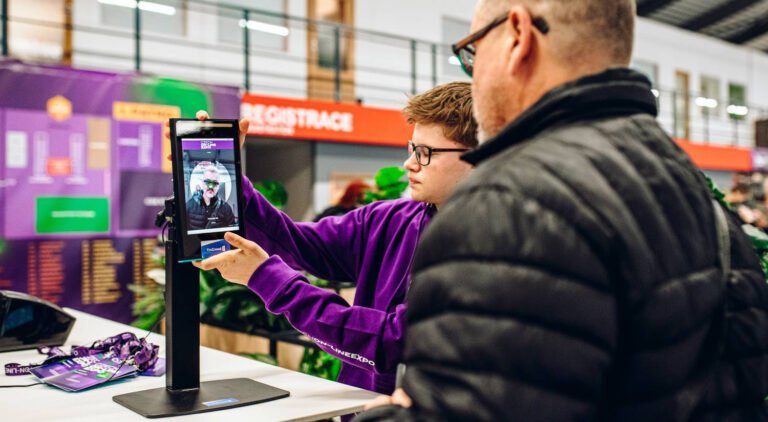
Biometric ticketing ROI isn’t just about reducing queues. It’s about rethinking what event entry delivers in terms of operational efficiency, stronger security, enhanced fan satisfaction, and new commercial value.
In a recent podcast conversation, industry leaders explored how biometric ticketing works in real venues, and why identity-based entry deserves serious consideration from clubs and venue operators.
The full podcast is available here: Dave Wakeman’s The Business of Fun Podcast.

What Is a Biometric Ticket?
At its simplest, a biometric ticket replaces traditional paper or mobile tickets with a person’s unique identity, most commonly their face. Instead of scanning a barcode or showing a ticket, fans move through an entry point where their identity is verified automatically.
A critical point addressed in the podcast is how modern biometric systems handle data. These systems do not store raw images of people’s faces. Instead, they generate an encrypted mathematical representation that can be matched at entry. In many cases, that data is deleted after the event or retained only when a fan explicitly opts in for future use.
This distinction matters. It directly addresses many of the concerns people instinctively associate with biometric technology.
Why Biometric Ticketing ROI Is Compelling
One of the most compelling themes from the conversation is the financial impact of biometric ticketing. Venues often fixate on upfront implementation costs, but that narrow view misses the broader biometric ticketing ROI picture.
When evaluated holistically, identity based ticketing creates value across multiple dimensions. It reduces staffing needs at entry points, speeds up entry and shortens lines, lowers fraud and chargeback rates, and increases in venue spending by getting fans inside earlier and in a better mood. It also enables more sophisticated sponsorship opportunities that go beyond static branding to deliver measurable activation experiences.
For venues hosting frequent events, these benefits compound over time, making the return on investment increasingly difficult to ignore.
Biometric Ticketing as a Sponsorship Enabler
One of the most underestimated aspects of biometric ticketing ROI is its ability to unlock sponsorship value.
Biometric systems do not just streamline entry. They create new sponsor friendly touchpoints that do not exist in traditional ticketing workflows. Seamless identity verification allows venues to link experiences, access, and benefits to individual fans in a way that is frictionless and measurable.
From a sponsor’s perspective, this opens the door to branded experiences tied directly to verified attendance. A sponsor can underwrite a biometric fast track lane or a premium access moment, with precise data showing how many fans used it and when. That level of attribution is extremely difficult to achieve with static signage or conventional branding.
Sponsors today want more than logos. They want meaningful engagement. Biometric entry connects real people to real moments without relying on scans, clicks, or self reported data. A brand can demonstrate not just visibility, but a tangible improvement to the fan experience.
There is also a natural alignment with premium sponsorship categories. Financial services firms, technology companies, and consumer platforms that already emphasize security, identity, and seamless user experiences are particularly well positioned to sponsor biometric enabled access. In these cases, the technology itself reinforces the sponsor’s brand narrative.
Crucially, this sponsorship value can offset the cost of implementation. Rather than viewing biometric ticketing as a pure operational expense, venues can position it as a sponsor supported enhancement to the fan journey. In some cases, a single activation can cover the full system cost.
This model also scales. Once biometric identity is in place, it can support multiple sponsored touchpoints from entry to lounges to age verified purchases. Each touchpoint delivers measurable value to partners while keeping the experience fast and intuitive for fans.
How Venues Should Get Started
For venue operators interested in identity based ticketing, the recommendation is to start small. A pilot focused on a single gate, event type, or audience segment allows venues to gather real world data without unnecessary risk.
By measuring entry speed, staffing costs, fan satisfaction, and revenue impact together, venues gain a complete picture. When these metrics are evaluated in combination rather than isolation, the return on investment often becomes clear very quickly.
Addressing Common Privacy Concerns
Privacy is often the first issue raised when identity based ticketing comes up. Transparency is essential. Fans need to clearly understand what data is collected, how it is used, and how long it is retained.
When venues take the time to explain this and design systems that are opt in, adoption rates tend to be much higher than many expect. Fans are rarely drawn to the technology for its own sake. What motivates them are practical benefits such as faster entry, less friction, and a smoother overall experience.
Final Thoughts
Biometric ticketing ROI isn’t hypothetical. Identity-based entry technology like face ticketing enhances fan experience, improves venue efficiency, and unlocks real commercial opportunities. As biometric solutions continue to mature and integrate seamlessly with current systems, venues that adopt thoughtful, transparent implementations will see benefits that extend far beyond faster entry.